When a Coffee Lover Meets SerpApi
If you have ever built an agent with Langchain/Langgraph, you cannot miss SerpApi. And I almost did - because every major tutorial uses search as a demo, I skipped that part entirely when teaching.
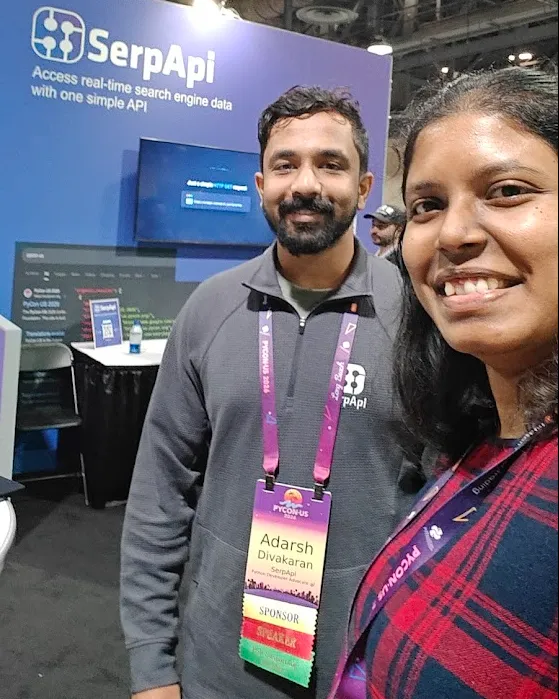
It all changed when Adarsh from SerpApi pinged me before Pycon US inviting me to visit their booth and I did. He walked me through what’s cool about SerpApi and why I should try it.
It’s not just Google Search
That was my blind spot. The engines available through SerpApi go well beyond web search - Google Jobs, Shopping, Scholar, News, Maps Local Results, Lens, YouTube, Bing. Each one returns structured data. Not HTML you have to parse and clean. Actual fields.
Job title, company, salary, location - all in one response from Google Jobs. Product price, seller, availability - one call to Google Shopping. Academic papers, citations, authors - Google Scholar. News source, publish time, related topics - Google News.
Google’s own UI spreads this across multiple screens with ads in between. SerpApi hands it to you in one JSON response. Companies making decisions off their Google rankings don’t want to maintain a fleet of scrapers that break every time the UI changes. A stable, structured API is the obvious alternative.
I was fully sold when Adarsh mentioned Perplexity, Adobe, and Shopify all use their API for search. I had to go back and try it.
The project ideas that got me excited
I started seeing what people were building. I collected all the LinkedIn posts I could find.
Ariana Cursino built a Pyladies skill gap analyser.
Dara Corr built MenuVision, converting menu items into visual dishes for easier ordering.
Pabbiti Vamsi built TruthLens, an open-source fake news detector that fetches live search and news results through SerpApi to verify claims.
Bhavneet Singh built an AI news summarizer agent on top of the News API.
Arun M.R. used it as the web search layer in a RAG agent.
The shopping use case hit differently - Kaushik Joshi built SmartStock CRM and used SerpApi to surface trending products. That’s exactly the product-market fit signal people usually pay for.
The one that stuck with me: ShieldHer by Nitheesh A and Kiruthika A, a women’s safety app that uses Google Reverse Image Search via SerpApi. That’s Google Lens doing real work in a real product. Malik Faiz used the image search APIs to pull relevant visuals for a LinkedIn AI posting agent.
Rajlaxmi Bahirat’s team used it for live flight data in an AI travel planner.
Travel, shopping, food, news, jobs - they touched everything. But nobody had built the one I actually wanted. A coffee finder that surfaces the good spots before everyone else finds them.
What I built
If you know anything about me, I’m no coffee nerd but I love a good coffee. I also like trying places that are cozy, hidden, tucked away, not the ones every food blogger has already posted about. The viral spots don’t need more limelight. The new ones could use a boost.
The idea: find great coffee shops before they get discovered. Before the wait times go up, before the vibe changes.
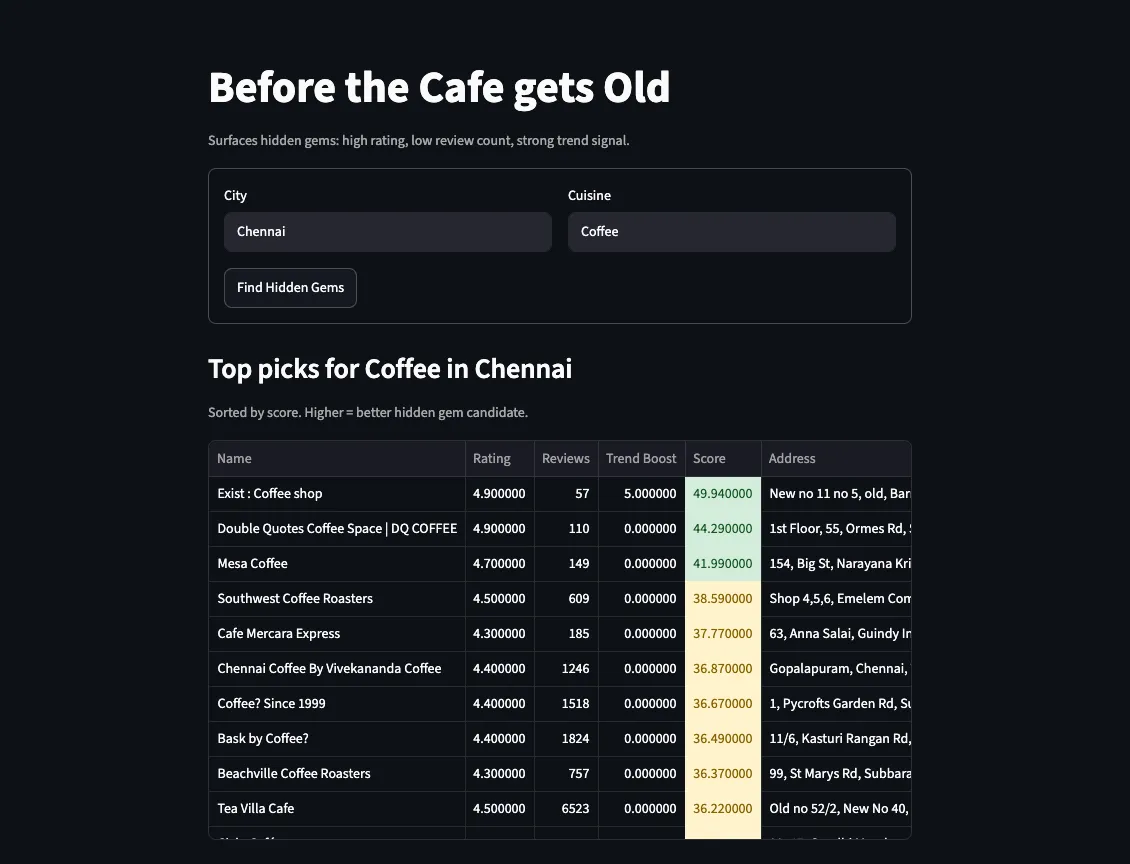
I used the Google Maps Local Results engine.
results = client.search(
    engine="google_maps",
    q=f"{cuisine} restaurants in {city}",
    type="search",
)
# Returns: rating, reviews, price, hours, thumbnails,
# owner_answer, extensions, popular_times...
One call gives you rating, review count, photo count, price tier, hours, whether the owner responds to reviews, Google’s popular signal. Things I’d have needed five different data sources for, or a lot of painful HTML parsing, all in one response.
Then came the real problem: how do you actually score a “hidden gem”?
Simple Ratio
score = rating / review_countPenalize popular places by dividing by how many reviews they have. Makes sense on paper. Except a ghost kitchen with 5 stars and one review scores 5.00 and wins every time. Pure noise.
Bayesian average
score = (C * global_mean + n * rating) / (C + n)Weight each rating against a global prior so low-volume places regress toward the mean. Two problems: you need the whole list of cafes before calculating the global mean. And even then, everything clusters near the average - actual gems disappear into the middle.
Wilson score
score = wilson_lower_bound(positive_rate, confidence=0.95, n=review_count)Confidence interval lower bound. This is what Reddit used for comment ranking. It’s mathematically sound for ranking under uncertainty. Except it’s built for binary ratings - thumbs up or thumbs down. A 5-star scale doesn’t map cleanly onto it.
Extracting Trends
score = (avg_rating * 10) - math.log(review_count + 1) + trend_multiplieravg_rating * 10→ rewards quality directly- math.log(review_count + 1)→ penalizes popularity, but logarithmically - the penalty grows slowly, so a place with 500 reviews isn’t destroyed, just bumped down appropriately+ trend_multiplier→ adds back for recency signals from SerpApi
The trend_multiplier is what makes it interesting. Recently opened, owner actively responding to reviews, high photo-to-review ratio (people posting photos before they bother writing reviews - that’s a freshness signal). The formula surfaces places with strong quality signals but low discovery. Hidden gems, while they’re still hidden.
The full project is on GitHub: github.com/thelearningdev/serpapi-tutorial
Time to Build things
SerpApi provides 250 searches per month, no card required. I built and validated the whole coffee finder concept on the free tier before even thinking about costs.
If any of these ideas clicked for you - jobs board, price tracker, LLM grounding, local discovery - pick an engine, look at what one API response returns, and build it today.